EN
EN
VN
EN
EN
VN

17/08/2026
On the morning of August 15, 2026, the “Smart Police Station” Kiosk model was officially introduced for pilot implementation in Hanoi. The model forms part of the Multi-Utility Kiosk Ecosystem led by the Police Department for Administrative Management of Social Order (C06) under the Ministry of Public Security, in coordination with relevant organisations. It aims to leverage population data, digital identity and electronic authentication to provide citizens with more convenient, secure and efficient access to public security services.
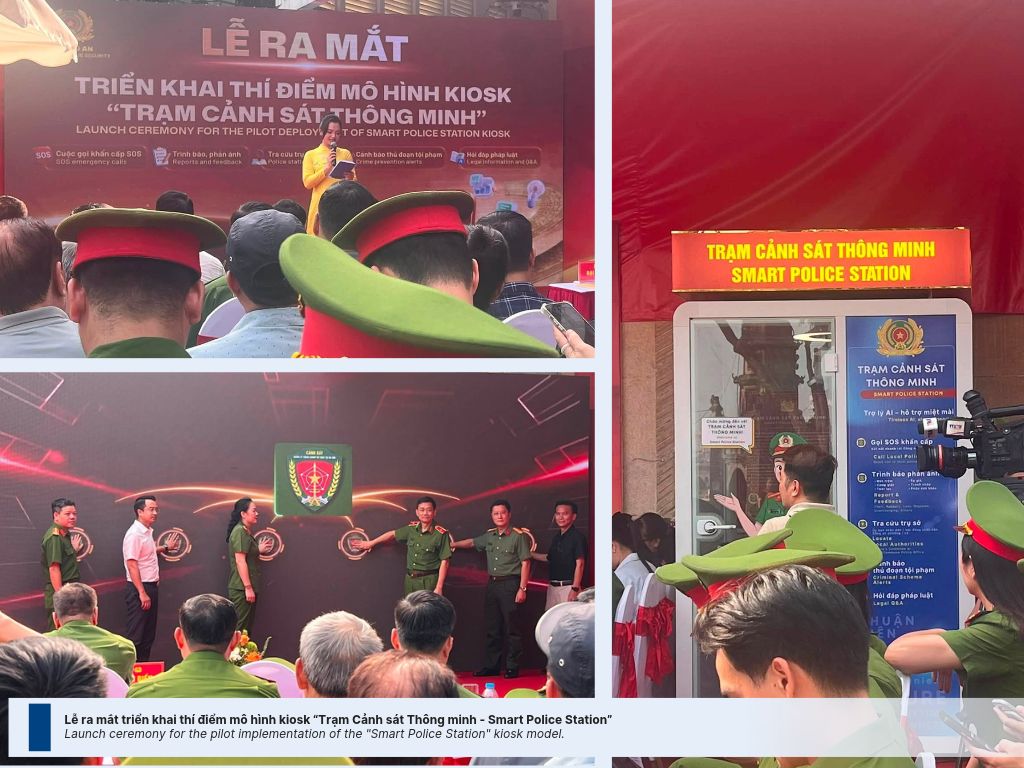
During the pilot phase, the Smart Police Station provides five key groups of functions: incident reporting and public feedback; SOS emergency calls; crime and fraud alerts; police station lookup; and legal information and enquiries.
Beyond providing an additional channel for citizens to submit information, one of the model’s key features lies in the workflow behind the Kiosk. For incident reporting and feedback, AI and voice technologies guide users through the information submission process, automatically convert spoken information into text, and prompt users to provide missing details, helping create more complete and structured reports.
The information is subsequently recorded in the Ministry of Public Security’s incident reporting and feedback processing system and transferred to the responsible police unit for handling. The relevant authorities can then proactively contact citizens, provide guidance and support throughout the case-handling process, while information and processing results are updated in the system.
The value of the Smart Police Station therefore extends beyond creating another point of contact between citizens and the police. The model is designed to support an end-to-end process covering information reception, recording, case routing, citizen support and result updates, contributing to greater transparency and efficiency in handling reports and public feedback.
The SOS function, meanwhile, operates as an independent emergency support channel, enabling citizens to quickly connect with local police forces in situations requiring an immediate response.
From operational requirements to technology solutions
Smart Police Station models have been introduced in various forms in a number of countries and cities around the world. However, the challenge in Vietnam is not simply to replicate an existing international model.
Based on practical requirements, C06 has developed the operational framework and guided the development of a model aligned with Vietnam’s population database, digital identity and electronic authentication infrastructure. Particular emphasis has been placed on the application of AI, automation of information reception and processing, integration with operational systems, as well as cybersecurity, information security and personal data protection.
Under the principles established by C06, functions performed by citizens through the Kiosk must ensure: the right person – the right data – the right process – in compliance with the law. This principle is also applied across C06’s broader Multi-Utility Kiosk Ecosystem.
Working alongside C06, MK Group has participated in the design, development and implementation of Smart Police Station solutions, translating operational requirements into a technology system capable of functioning in real-world environments. The collaboration between government authorities and technology enterprises also reflects an approach in which public-sector technology infrastructure and private-sector innovation capabilities can complement each other to deliver practical value to citizens.
Towards smarter, citizen-centric public services
Hanoi is the first locality in the country to pilot the Smart Police Station Kiosk model. In the next phase, the model is expected to continue being studied and refined, with additional services and utilities associated with population data, citizen identification, digital identity and VNeID electronic authentication to be progressively integrated.
Through the project, MK Group looks forward to continuing its cooperation with C06 and relevant organisations in bringing technology into practical applications, contributing to reducing the workload of local police forces, improving the effectiveness of public security and order management, and progressively expanding smart, citizen-centric services.
05/10/2026
30/09/2026
21/09/2026
14/09/2026

14/08/2026